
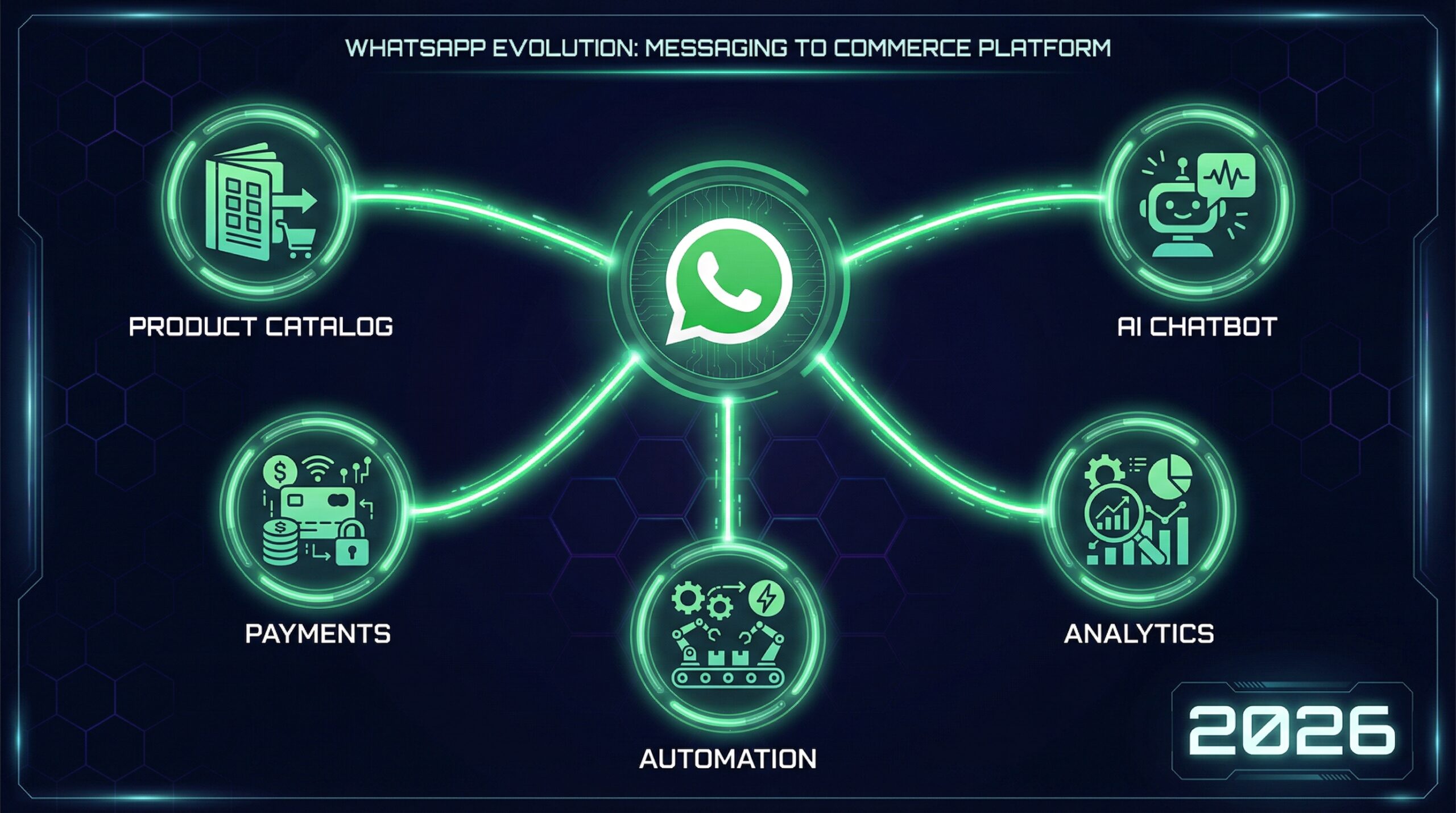
WhatsApp is not just a messaging app anymore. In 2026, it is a full commerce platform where customers discover products, ask questions, and complete purchases without ever leaving the chat. With 3+ billion monthly active users and business features evolving rapidly, WhatsApp is reshaping how Shopify merchants sell online.
The shift is already happening. Conversational commerce through WhatsApp achieves 40%+ conversion rates using in-chat product catalogs, WhatsApp Flows, and integrated payments (TrueFan, 2026). That is 8-10x higher than the average ecommerce website conversion rate.
This article covers the WhatsApp commerce trends that matter most for Shopify store owners in 2026: AI-powered customer conversations, in-chat shopping experiences, new payment capabilities, and the automation strategies that are generating the best results right now.
The Shift to Conversational Commerce
Conversational commerce is the trend driving everything else on this list. Customers increasingly prefer to shop through conversations rather than browsing traditional websites. WhatsApp is the platform making it happen at scale.
What Is Conversational Commerce?
Conversational commerce is buying and selling through messaging apps. Instead of browsing a website, adding items to a cart, and going through a multi-step checkout, customers discover and purchase products through a chat conversation.
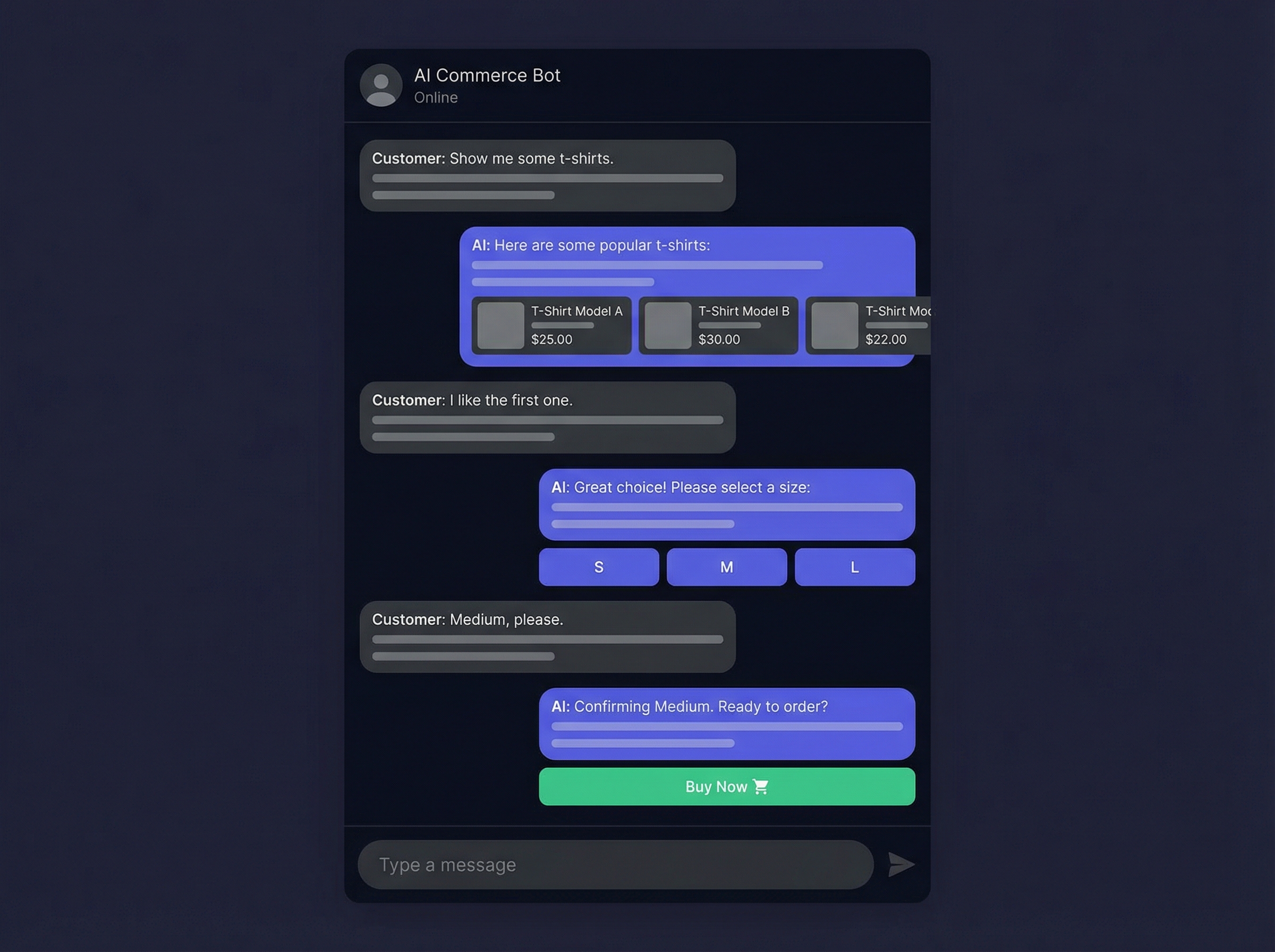
On WhatsApp, this looks like:
- Customer messages your business
- AI chatbot or human agent shows relevant products from your catalog
- Customer selects items and adds them to an in-chat cart
- Payment happens within WhatsApp (where available) or via a payment link
- Order confirmation arrives in the same chat thread
The entire purchase journey happens in one interface. No app switching, no website loading, no checkout friction.
Why Shopify Merchants Should Pay Attention
95% of WhatsApp messages get opened and the response rate exceeds 55% (yCloud, 2026). Compare that to ecommerce website conversion rates of 2-3%. The math is clear: reaching customers where they already spend their time produces dramatically better results.
For Shopify stores, conversational commerce is not about replacing your website. It is about adding a high-conversion channel that handles the customers who prefer messaging over browsing.
Trend 1: AI-Powered Customer Conversations
AI chatbots on WhatsApp have evolved beyond basic FAQ responders. In 2026, they are genuine sales assistants that understand product catalogs, customer preferences, and purchase context.
How AI Chatbots Are Changing WhatsApp Commerce
Starting January 2026, WhatsApp implemented a new AI policy that allows structured, purpose-specific chatbots for customer support, order tracking, product recommendations, and commerce (Turn.io, 2026). These are not the robotic chatbots of 2023. They understand natural language, provide personalized recommendations, and handle complex product questions.
What AI chatbots can do for Shopify stores in 2026:
- Product discovery: “Show me summer dresses under $50 in size M”, chatbot filters your catalog and shows matching products
- Sizing and fit help: Answers sizing questions using your product data and past customer feedback
- Comparison shopping: “What is the difference between the Pro and Basic moisturizer?”, chatbot provides a clear comparison
- Order tracking: Customer asks about their order, chatbot pulls real-time Shopify data
- Personalized recommendations: Based on purchase history and browsing behavior
The Impact on Shopify Sales
Companies responding within 15 minutes see up to 80% higher conversion rates (Chatarmin, 2025). AI chatbots respond in seconds, 24/7. For Shopify stores that cannot afford a full-time customer service team on WhatsApp, AI fills the gap without compromising response time.
D2C brands are already using WhatsApp AI chatbots to boost sales by handling product questions that previously went unanswered, leading to abandoned carts and lost revenue.
Trend 2: In-Chat Shopping Experiences
WhatsApp’s commerce features now support the entire shopping journey inside the chat interface.
WhatsApp Catalogs
WhatsApp Business catalogs let you showcase your product inventory directly in chat. Customers browse products with images, descriptions, and prices without leaving the conversation. For Shopify stores, catalogs can sync with your product feed, keeping WhatsApp up to date when you add or modify products.
WhatsApp Flows
WhatsApp Flows are structured, multi-step forms that run inside the chat interface. For commerce, they handle:
- Product configuration: Size, color, quantity selection in a guided flow
- Address collection: Shipping address without redirecting to a website
- COD confirmation: One-tap verification for Cash on Delivery orders
- Returns and exchanges: Structured form for processing returns
Flows reduce friction by keeping everything in WhatsApp. Customers do not need to click through to your website to complete an action.
In-Chat Payments
Where supported (India via UPI, Brazil via Pix, and expanding), customers can pay directly within WhatsApp. For regions without native WhatsApp payments, businesses share secure payment links that open the payment process in a browser and return to the WhatsApp conversation after completion.
The impact is significant: chat-to-purchase funnels with WhatsApp Flows and in-chat payments achieve 40%+ conversion rates (TrueFan, 2026). That number will only grow as payment support expands to more countries.
Trend 3: Automated Commerce Workflows
Automation is the engine that makes WhatsApp commerce scalable for Shopify stores.
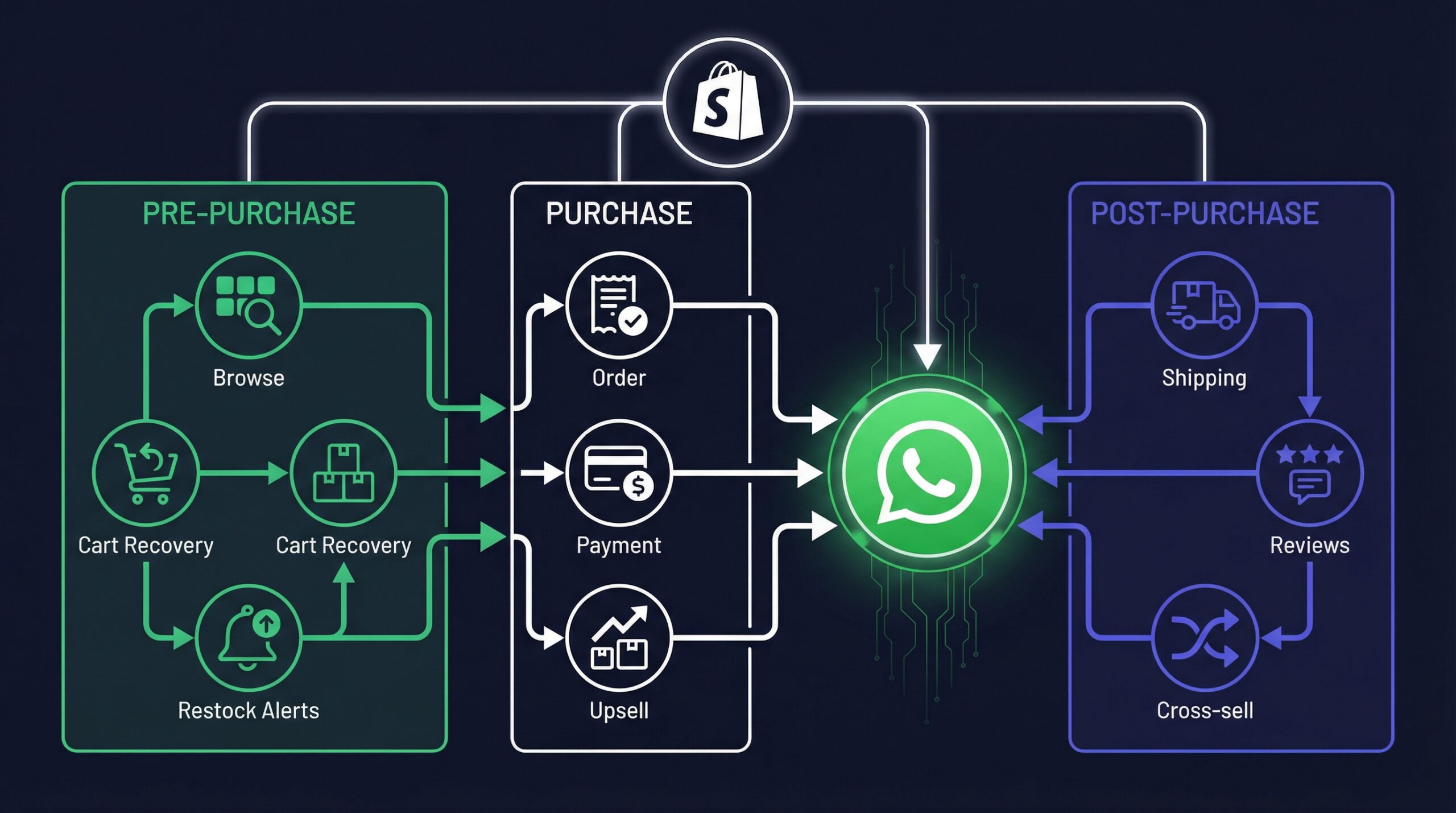
Pre-Purchase Automation
- Welcome sequences: New subscribers receive a curated product recommendation based on how they found your store
- Browse abandonment: Customer viewed a product but did not add to cart, trigger a WhatsApp message with that product
- Back-in-stock alerts: Automated WhatsApp restock notifications the moment inventory returns
Purchase-Phase Automation
- Cart recovery: Automated reminders for abandoned checkouts (30-40% recovery rates)
- COD verification: Instant order confirmation for Cash on Delivery to reduce return-to-origin
- Upsell at checkout: Suggest complementary products before the customer completes payment
Post-Purchase Automation
- Order confirmation: Instant WhatsApp notification with order details
- Shipping updates: Real-time tracking messages at every fulfillment milestone
- Review collection: Automated review request 5-7 days after delivery
- Cross-sell: Product recommendation based on what the customer bought
For a complete overview of all WhatsApp notification types for Shopify, including setup instructions and cost breakdowns, see our detailed guide.
Trend 4: WhatsApp as a Revenue Channel (Not Just Support)
The biggest mindset shift in 2026: WhatsApp is a revenue-generating channel, not just a customer support tool.
From Support to Sales
Historically, Shopify stores used WhatsApp primarily for customer support: answering questions, handling complaints, processing returns. In 2026, the most successful stores use WhatsApp as a primary sales channel:
| WhatsApp Function | 2024 | 2026 |
|---|---|---|
| Customer support | Primary use | Still important |
| Order notifications | Growing | Standard practice |
| Cart recovery | Emerging | Major revenue driver |
| Product discovery | Rare | Growing fast |
| In-chat purchases | Not available | Active in key markets |
| AI sales assistant | Experimental | Mainstream |
| Promotional campaigns | Basic broadcasts | Sophisticated, segmented |
Revenue Metrics for Shopify Stores
WhatsApp commerce delivers 57.4x ROI across 30+ ecommerce brands (Chatarmin, 2025). The stores generating this return share three common strategies:
- Segmented messaging: Different messages for different customer groups based on purchase behavior
- Two-way conversations: Not just broadcasts, but actual conversations that build relationships
- Strategic restraint: Limiting promotional messages to prevent fatigue and maintain high engagement
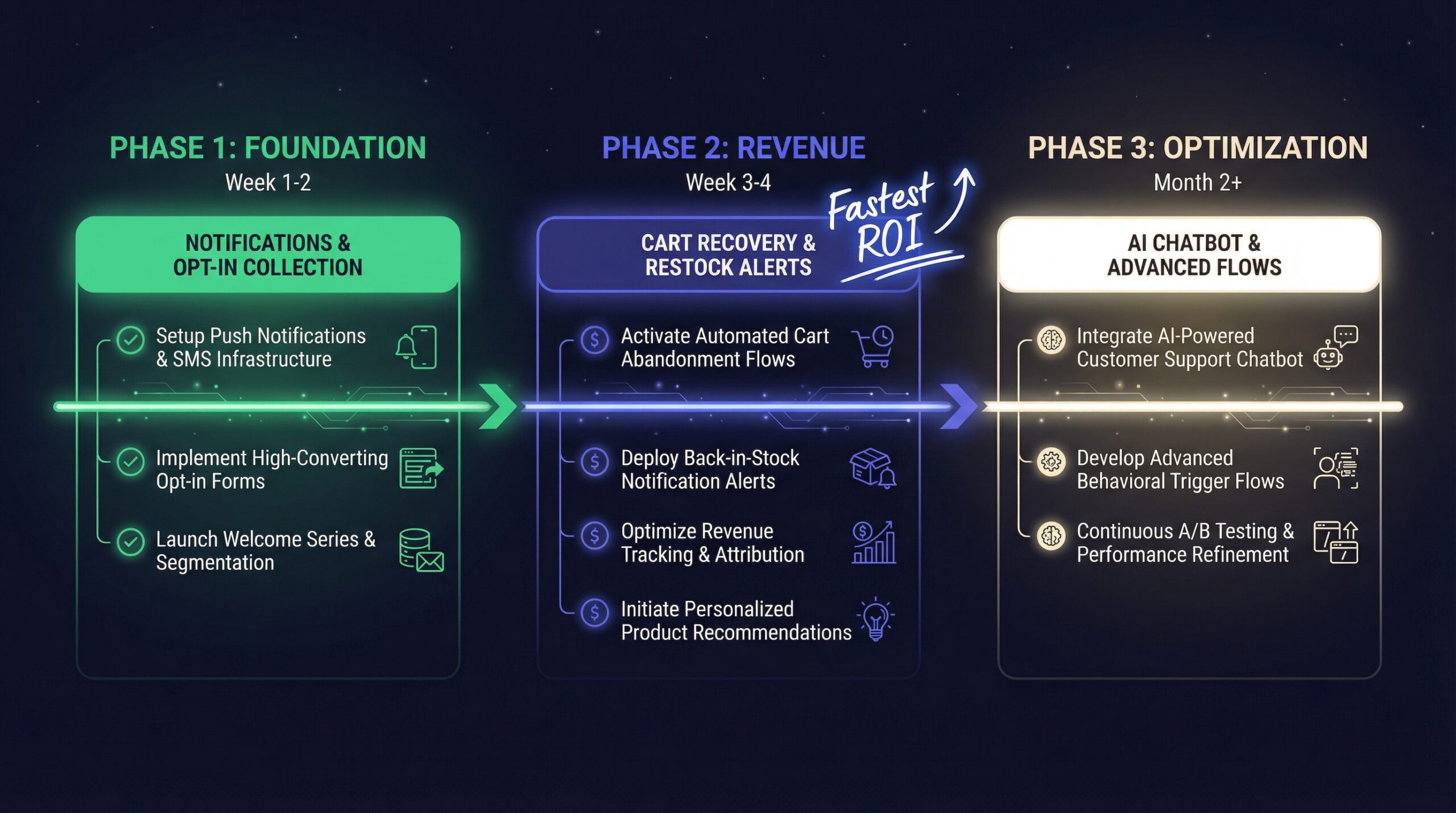
The WhatsApp Commerce Playbook for Shopify
Here is the practical approach for Shopify merchants who want to leverage these trends:
Phase 1: Foundation (Week 1-2):
- Install a WhatsApp-capable notification app
- Set up automated order confirmations and shipping updates
- Add WhatsApp opt-in to your Notify Me button and checkout
Phase 2: Revenue Generation (Week 3-4):
- Enable abandoned cart recovery on WhatsApp
- Set up WhatsApp back-in-stock alerts
- Launch your first promotional campaign to VIP customers
Phase 3: Optimization (Month 2+):
- Add AI chatbot for product questions and recommendations
- Create WhatsApp Flows for product configuration and returns
- Segment your audience and personalize messaging
- Test in-chat purchasing if available in your target markets
The key takeaway: start with notifications, graduate to sales. For guidance on the cost differences between channels, our WhatsApp vs email comparison breaks down the economics.
Trend 5: Privacy-First Commerce
Privacy regulations and consumer preferences are shaping how WhatsApp commerce works in 2026.
Opt-In Requirements Are Stricter
Meta has tightened opt-in requirements for WhatsApp Business API. In 2026, businesses must:
- Collect explicit, documented opt-in consent
- Clearly state what types of messages the customer will receive
- Provide one-tap opt-out in every message
- Maintain opt-in records for compliance audits
First-Party Data Advantage
As third-party cookies disappear and iOS tracking restrictions tighten, WhatsApp becomes even more valuable. Every WhatsApp subscriber is a first-party data point: you know who they are, what they want, and how to reach them.
For Shopify stores, this means WhatsApp subscriber lists are a strategic asset. Unlike social media followers or ad audiences, you own the relationship. Building your WhatsApp subscriber list now positions you well as other marketing channels become less effective.
53% of retailers already automate messaging over WhatsApp (Infobip, 2025). The early adopters are building subscriber lists and engagement patterns that will be extremely difficult for late entrants to replicate.
Frequently Asked Questions
Is WhatsApp commerce available for Shopify stores right now?
Yes. WhatsApp notifications (order updates, restock alerts, cart recovery) are fully available through Shopify apps. In-chat purchasing is available in select markets. AI chatbots and catalog features are available through BSPs.
Do I need to build a separate WhatsApp store?
No. WhatsApp commerce works alongside your existing Shopify store. Your Shopify product data syncs to WhatsApp catalogs, and purchases made via WhatsApp links are processed through your Shopify checkout.
How much does WhatsApp commerce cost for Shopify stores?
Costs include a BSP subscription ($15-50/month), per-message API fees ($0.01-0.22 depending on country and message type), and optionally AI chatbot services ($50-500/month). See our WhatsApp marketing cost breakdown.
Will WhatsApp replace email marketing for Shopify stores?
No. WhatsApp complements email, it does not replace it. Email remains the most cost-effective channel for regular communications. WhatsApp excels at high-intent, time-sensitive messages. The best Shopify stores use both channels strategically.
What is the best way to start with WhatsApp commerce?
Start with automated restock emails as your foundation, then add WhatsApp notifications for back-in-stock alerts and cart recovery. These two use cases deliver the fastest ROI and teach you how your customers respond to WhatsApp messaging.
Prepare Your Shopify Store for WhatsApp Commerce
The WhatsApp commerce trends of 2026 are not distant predictions. They are happening right now. AI chatbots, in-chat shopping, automated commerce workflows, and privacy-first subscriber lists are already generating results for Shopify stores that adopted early.
The most important step you can take today: start collecting WhatsApp opt-ins. Every subscriber you add to your list now is a customer you can reach through the highest-engagement channel available.
Set up back-in-stock notifications with email and WhatsApp collection from a single form. Start building the subscriber list that will power your WhatsApp commerce strategy in 2026 and beyond.