ChatGPT processes 50 million shopping queries every day across 900 million weekly users (Dataslayer, 2026). Perplexity shows product cards. Google AI Mode shortlists 3-5 products. None of them read your products the way a human shopper does. They read your data.
Your Shopify product data quality determines whether AI shopping agents can understand, match, and recommend your products. Stores with near-complete product attributes (what the industry calls a “Golden Record”) see 3-4x higher visibility in AI recommendations compared to stores with sparse data (Opascope, 2026). Most Shopify stores are nowhere close.
Days 1-4 of this series covered what happens when AI shoppers find your product out of stock, how protocols like Google UCP handle product availability, and how to optimize individual out-of-stock product pages for AI agents. Day 5 zooms out to your entire catalog. Here is what AI agents actually read, what they skip, and what to fix first.
What data sources do AI shopping agents pull from?
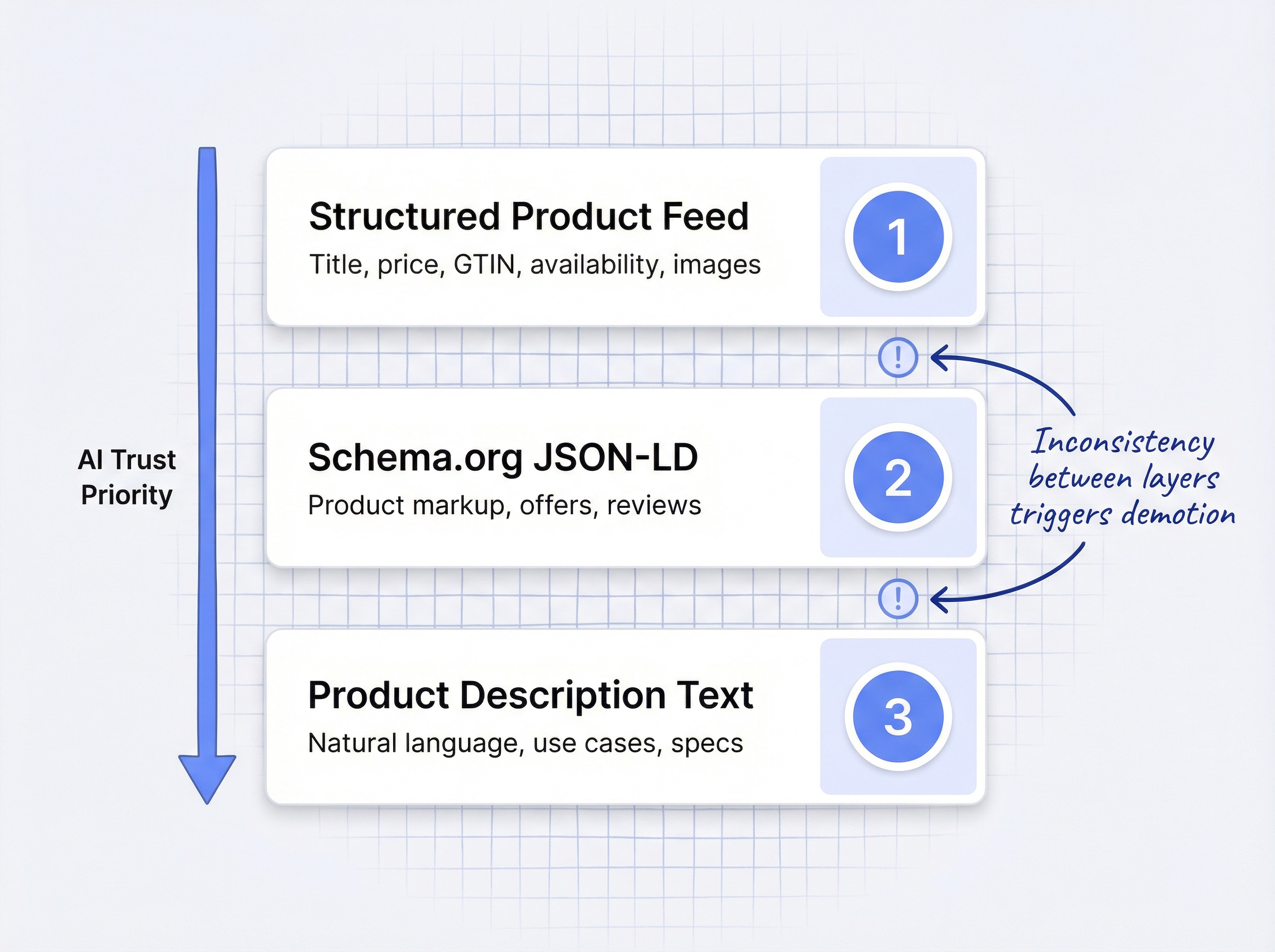
AI shopping agents evaluate your products using three data sources, and they trust them in a specific order.
| Priority | Data Source | What It Contains | Which AI Agents Use It |
|---|---|---|---|
| 1 (Highest) | Structured product feed | Title, description, price, GTIN, availability, images | ChatGPT, Google Shopping Graph, Perplexity |
| 2 | Schema.org JSON-LD markup | Product name, price, availability, brand, reviews | Google AI Mode, Bing Copilot |
| 3 | On-page description text | Natural language attributes, use cases, specs | All LLM-based crawlers |
The feed is the highest priority source. ChatGPT’s product feed specification requires merchants to supply title, description, price with ISO 4217 currency code, availability, images, and GTIN (OpenAI commerce feed specification). Feeds can be refreshed as often as every 15 minutes. Stale feeds push products out of the AI conversation entirely.
When data conflicts across these three sources (feed says $49.99, page says $59.99, schema has no price), AI agents treat the product as unreliable and skip it. Google’s Shopping Graph updates 2 billion product listings per hour across 50 billion+ entries (Google, 2025). Contradictions are flagged instantly.
How do product titles affect AI shopping recommendations?
Product titles are the first field AI agents read, and the most frequently wrong field across Shopify stores.
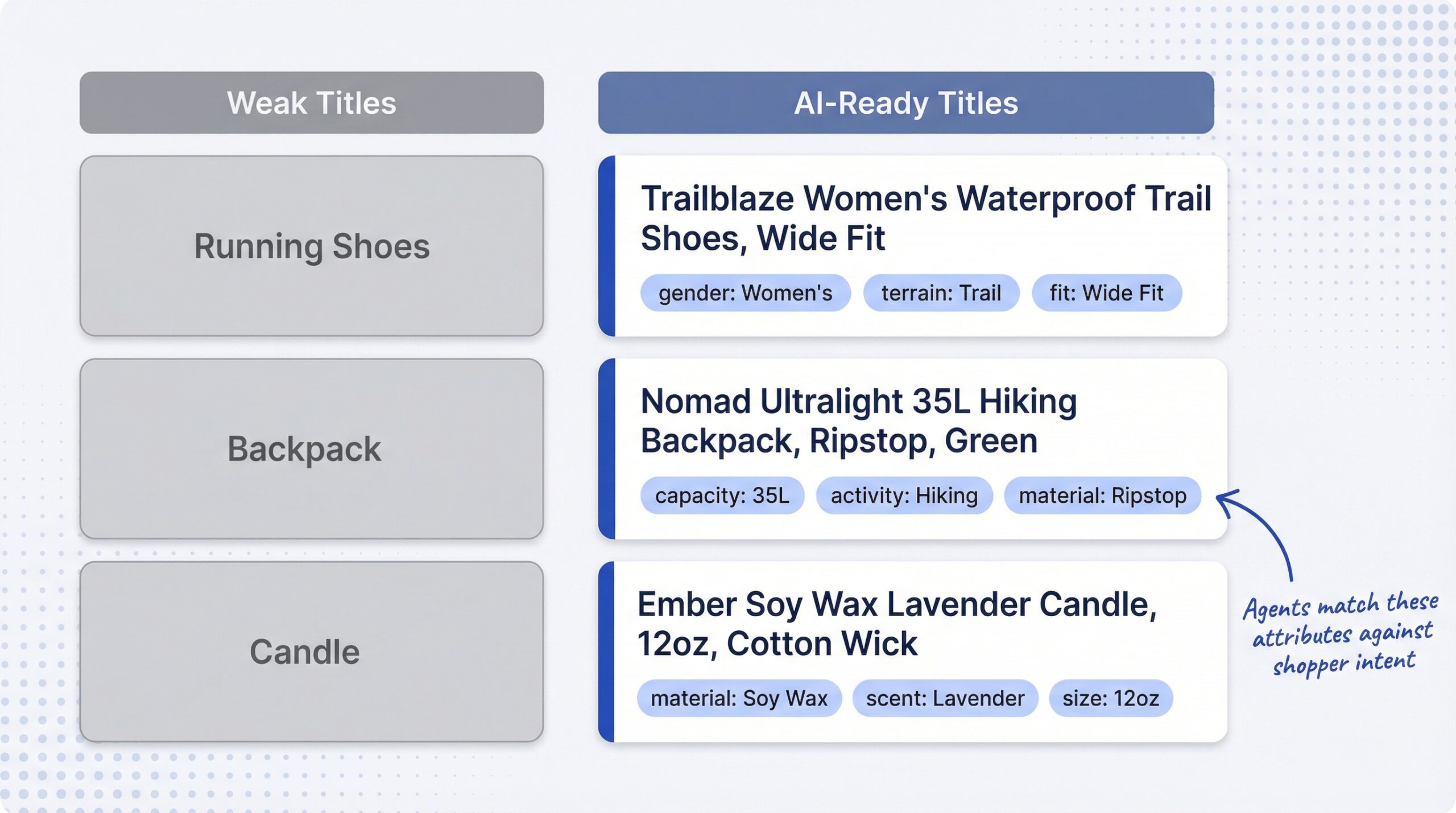
A title like “Running Shoes” gives an AI agent zero context. When a shopper asks ChatGPT for “women’s waterproof trail running shoes, size 8, blue,” the agent cannot match a title that contains no gender, terrain, weather rating, or color signal.
The AI-ready title formula:
[Brand] + [Gender/Audience] + [Product Type] + [Key Attribute] + [Color/Material]
| Weak Title | AI-Ready Title | What the Agent Can Now Extract |
|---|---|---|
| Running Shoes | Trailblaze Women’s Waterproof Trail Running Shoes, Wide Fit | Gender, terrain, weather, fit type |
| Backpack | Nomad Ultralight 35L Hiking Backpack, Ripstop Nylon, Forest Green | Capacity, activity, material, color |
| Candle | Ember Co. Soy Wax Lavender Candle, 12oz, Cotton Wick | Material, scent, size, wick type |
Character limits matter: 150 characters maximum for ChatGPT’s feed spec, 70 characters for Google Shopping’s primary title display. Lead with the most differentiating attribute if it is not the brand name.
Avoid keyword stuffing. AI agents penalize unnatural titles the same way search engines do. Write titles as if describing the product to a friend who has never seen it.
Why do descriptions and metafields matter more than ever for AI?
Thin product descriptions force AI agents to guess about your product’s attributes. Dense descriptions with natural language let agents match your product to nuanced, conversational queries.
When a shopper asks Perplexity “what’s a good gift for someone who does trail races?”, the agent does not search for “running shoes.” It looks for semantic matches: trail racing, gift-appropriate, durable, lightweight. Your description needs to contain those semantic bridges.
What makes a description AI-agent-readable:
- Open with a solution statement: “Designed for runners with flat feet who need arch support on technical trails”
- Include natural language attributes: Materials, use case, audience, compatibility, certifications
- Write in complete sentences: LLM crawlers parse sentence structure for meaning, not just keywords
- Target 150-300 words per product: Below 100 words, descriptions are too thin for attribute extraction
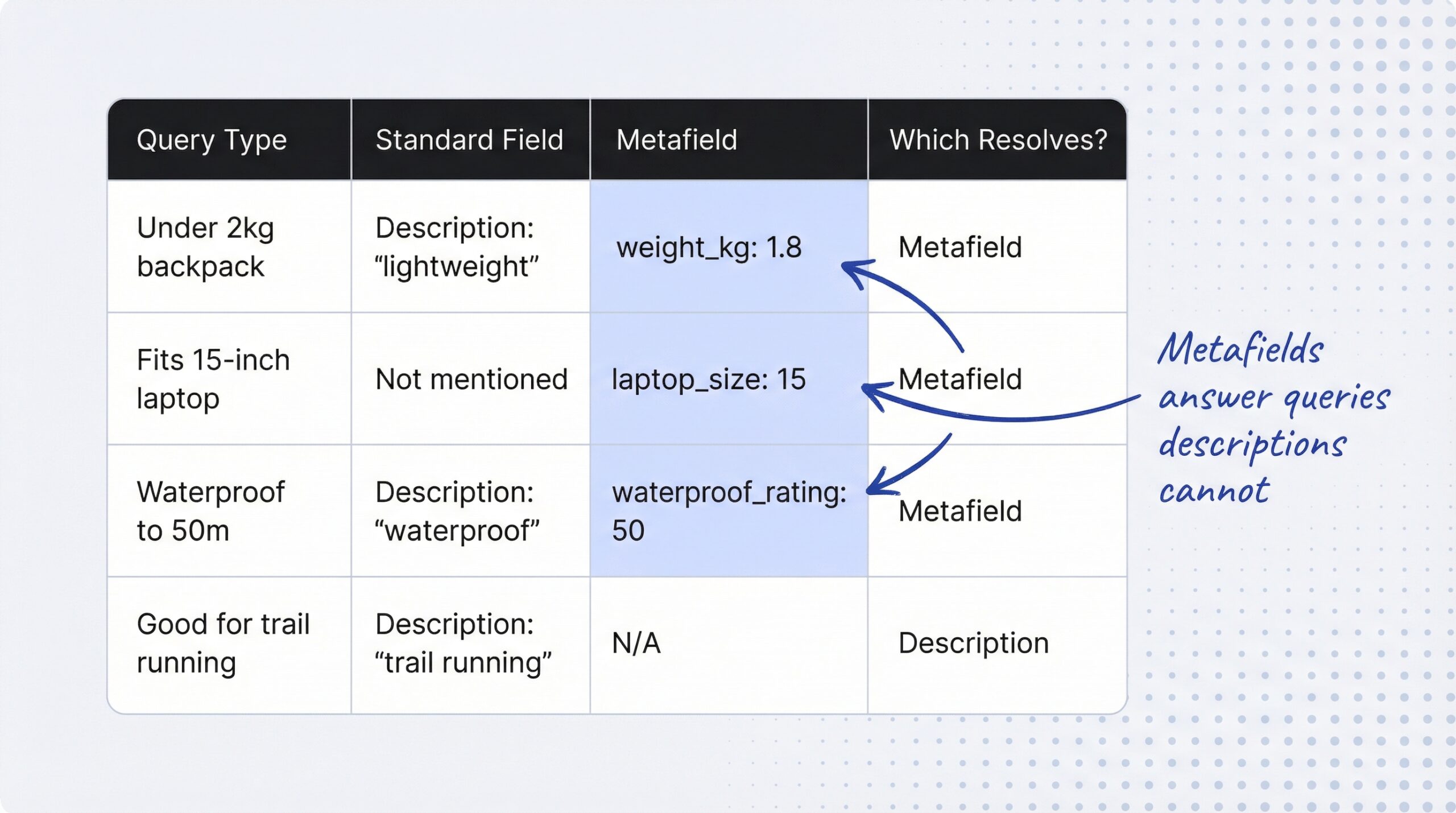
Shopify metafields are the highest-leverage fix for merchants with large catalogs. When an AI agent receives a query like “I need a lightweight backpack under 2kg for 3-day camping trips,” it can query the weight_kg metafield directly rather than parsing description prose. Without metafields, agents must guess, and they frequently miss the match.
| Query Type | Standard Field | Metafield | Which Resolves It? |
|---|---|---|---|
| “Under 2kg backpack” | Description mentions “lightweight” | weight_kg: 1.8 | Metafield (exact match) |
| “Fits 15-inch laptop” | Not mentioned | laptop_size: 15 | Metafield (exact match) |
| “Waterproof to 50m” | Description says “waterproof” | waterproof_rating_m: 50 | Metafield (exact match) |
| “Good for trail running” | Description says “trail running” | N/A | Description (semantic match) |
73% of data leaders cite data quality and completeness as the primary obstacle to AI success, ranking above model accuracy or computing costs (Feedonomics research on how AI ranks products).
What do AI agents see when they look at your product images?
Multimodal AI agents in ChatGPT, Google AI Mode, and Perplexity process both text and images. Your product images and their metadata are a direct input into recommendation decisions.
What multimodal agents read from images:
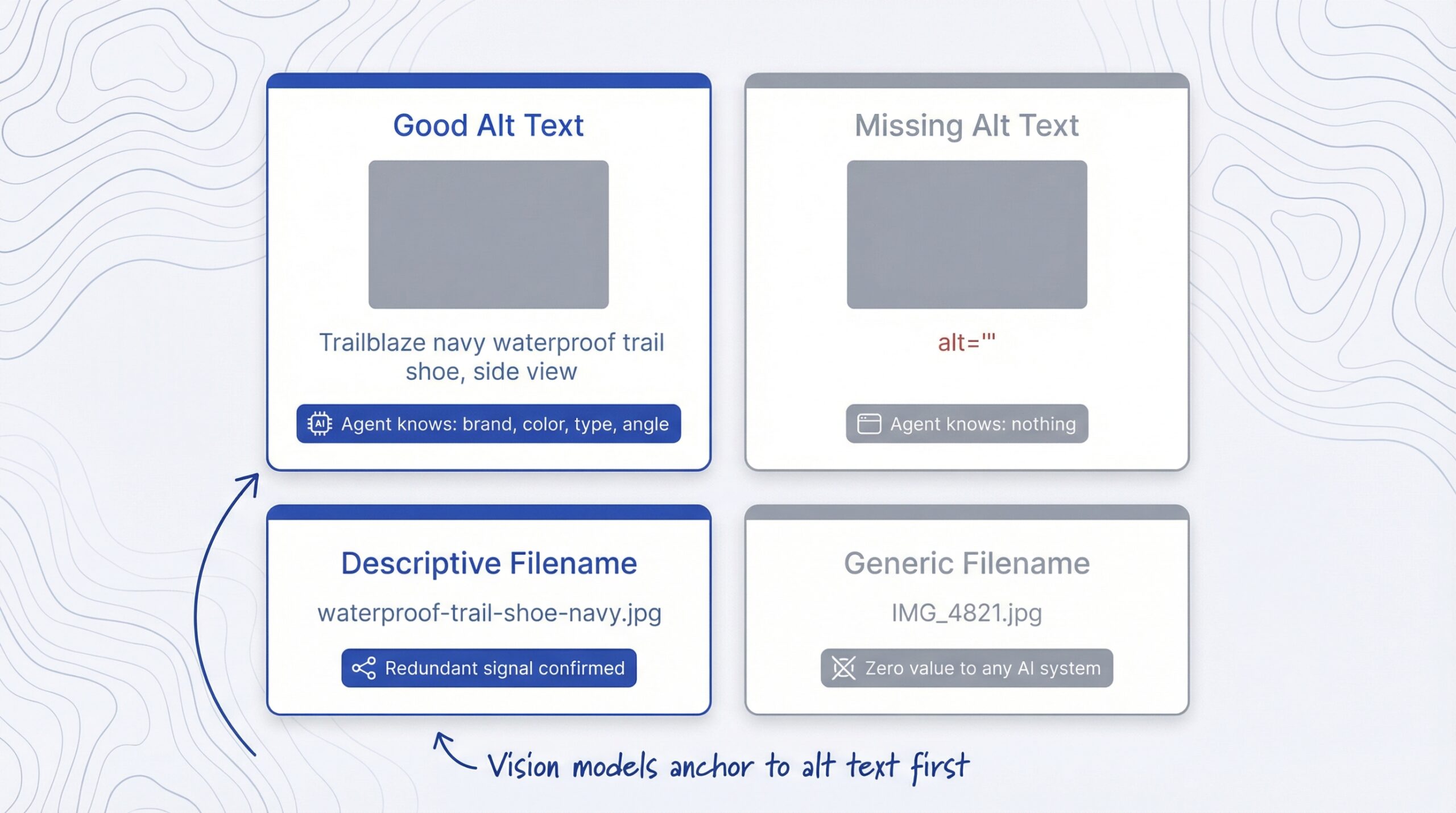
- Alt text: The text-layer description the vision model anchors to. Missing alt text means weaker confidence in what the image shows.
- File name: “merino-wool-crew-neck-navy.jpg” adds a redundant signal. “IMG_4821.jpg” adds zero value.
- Image count: Multiple angles (front, back, detail, lifestyle) give agents more visual data to resolve attribute ambiguity like exact color, texture, and scale.
- Resolution: High-resolution images are required for AI visual search. Low-resolution or blurry images reduce match confidence.
The correct alt text formula: [Brand] + [Product Type] + [Color] + [Key Feature]. For example: “Trailblaze navy waterproof trail running shoe with Vibram outsole, side profile view.”
Most Shopify stores leave alt text blank or auto-generated. This is one of the easiest data quality fixes to make across your catalog, and it compounds because every multimodal AI agent benefits from it.
How does pricing accuracy affect AI agent trust?
AI agents are trained to prioritize reliable merchants. Price or availability inconsistency between your Shopify store, product feed, and schema markup is one of the fastest ways to lose AI agent trust, and once lost, it is slow to recover.
Three pricing consistency rules:
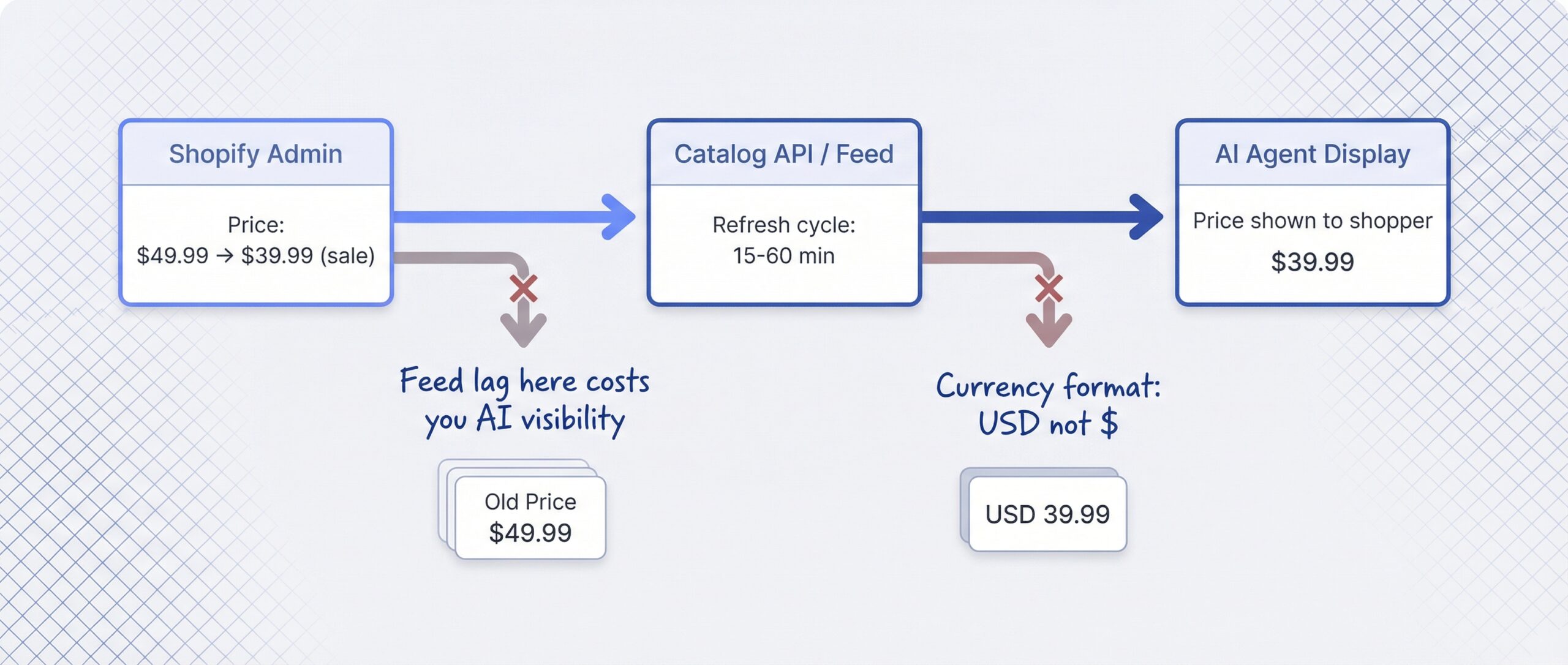
- Feed price and on-page price must match exactly, including sale price logic. When a promotion starts on your site but the feed has not refreshed, AI agents see the old price and may display incorrect information. ChatGPT’s feed spec expects refresh cycles as fast as every 15 minutes.
- Use ISO 4217 currency codes in all feeds (USD, GBP, EUR, not “$” or “dollars”). Ambiguous currency formatting causes parsing errors across AI platforms.
- Each variant needs its own GTIN, price, and availability. Group variants under a parent product entity. Do not create separate product listings for each size or color. AI agents prefer to recommend one coherent product and let the shopper select a variant.
The consequences of unreliable data are severe. Product data errors lead to 23% fewer clicks and 14% fewer conversions (McKinsey, 3,000+ e-commerce companies). 53% of shoppers abandon carts after encountering conflicting product details (GoDataFeed, 2025). AI agents observe these same trust signals and deprioritize merchants who repeatedly surface inaccurate data.
Merchants who handle out-of-stock products on Shopify with accurate availability data also keep their AI agent trust score intact. Stock status is a pricing accuracy problem as much as an inventory problem.
The catalog-wide data quality audit for AI shopping
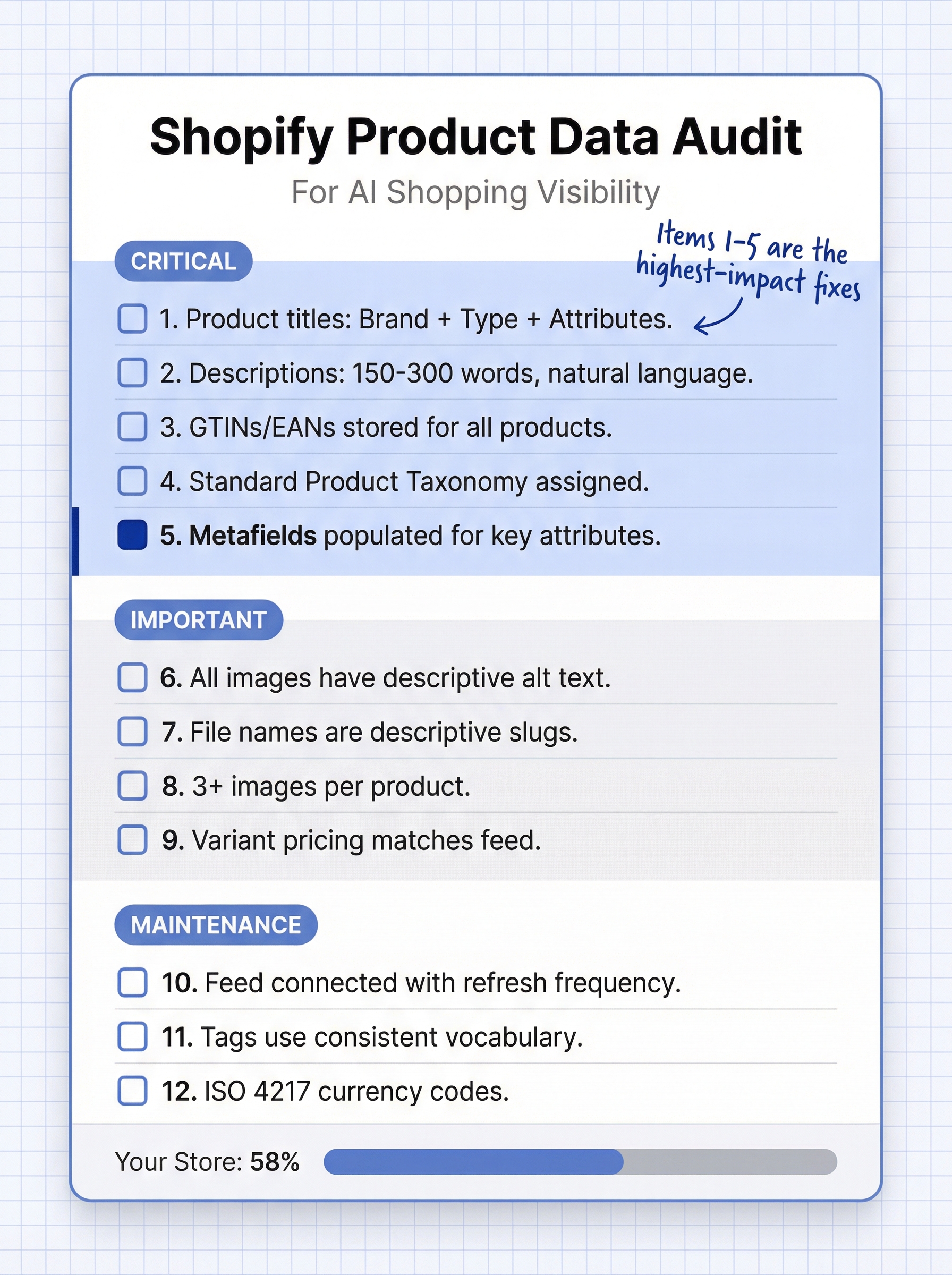
Run this audit across your Shopify catalog. Items are ordered by impact.
Critical (fix these first):
- Product titles follow [Brand] + [Type] + [Key Attributes] formula (no vague names, no SKU codes)
- Descriptions are 150-300 words with natural language attributes, materials, use case, and audience
- GTINs or EANs are stored for all products (required for ChatGPT feed and Google Shopping Graph matching)
- Shopify Standard Product Taxonomy category assigned for all products (not custom or blank)
- Metafields populated for key attribute dimensions (weight, material, compatibility, use case)
Important:
- All images have descriptive alt text: Brand + Type + Color + Feature
- Image file names are descriptive slugs, not “IMG_XXXX.jpg”
- Each product has at least 3 images (front, back, detail)
- Variant pricing is accurate and matches feed data exactly
Maintenance:
- Product feed is connected to Google Merchant Center and ChatGPT with appropriate refresh frequency
- Tags use consistent, attribute-based vocabulary
- Pricing uses ISO 4217 currency codes in all feed outputs
AI-driven orders to Shopify stores grew 15x from January 2025 to January 2026 (Shopify, 2026). GenAI shopping traffic surged 1,300% during the 2024 holiday season (Adobe Analytics data on generative AI shopping growth). Shopify’s own AI taxonomy system processes 30 million product classification predictions daily with an 85% acceptance rate (Shopify Engineering on product taxonomy at scale). The infrastructure is built. The agents are shopping. The question is whether your product data is ready for them.
Start with items 1 through 5 on this checklist. Then make sure your inventory is syncing accurately so that when products come back in stock, AI agents detect it immediately. A Shopify restock notification app closes the loop by alerting your customers the moment stock returns, turning accurate data into recovered revenue.
Frequently asked questions about Shopify product data and AI shopping
What product data fields do AI shopping agents read from Shopify?
AI agents read from three sources in priority order: your structured product feed (title, description, price, GTIN, availability, images), your on-page JSON-LD Schema.org markup, and your product description text via LLM crawling. The feed is highest priority. Missing or stale feed data means agents may ignore the product entirely.
How long should Shopify product descriptions be for AI agents?
Aim for 150-300 words per product. Include natural language attributes, a solution-framing opener, materials, use cases, and compatibility notes. Below 100 words, descriptions are too thin for confident attribute extraction by LLM-based crawlers.
Do Shopify metafields actually affect AI shopping recommendations?
Yes. Metafields are one of the highest-leverage fixes for merchants. When an AI agent gets a specific query (“under 2kg,” “fits a 15-inch laptop”), it queries metafields directly rather than parsing description prose. Merchants with structured metafields outperform those without on specific-intent queries.
Why does image alt text matter for AI product recommendations?
Multimodal AI agents process both text and images. Alt text is the text-layer anchor the vision model connects to. Missing alt text weakens the agent’s confidence in what the image shows. Use the formula: Brand + Product type + Color + Key feature.
How often should I update my Shopify product feed for AI shopping?
ChatGPT’s feed spec supports refresh cycles as fast as every 15 minutes. Google’s Shopping Graph processes 2 billion updates per hour. At minimum, feeds should refresh hourly. Stale pricing or availability data is one of the fastest ways to lose AI agent trust.