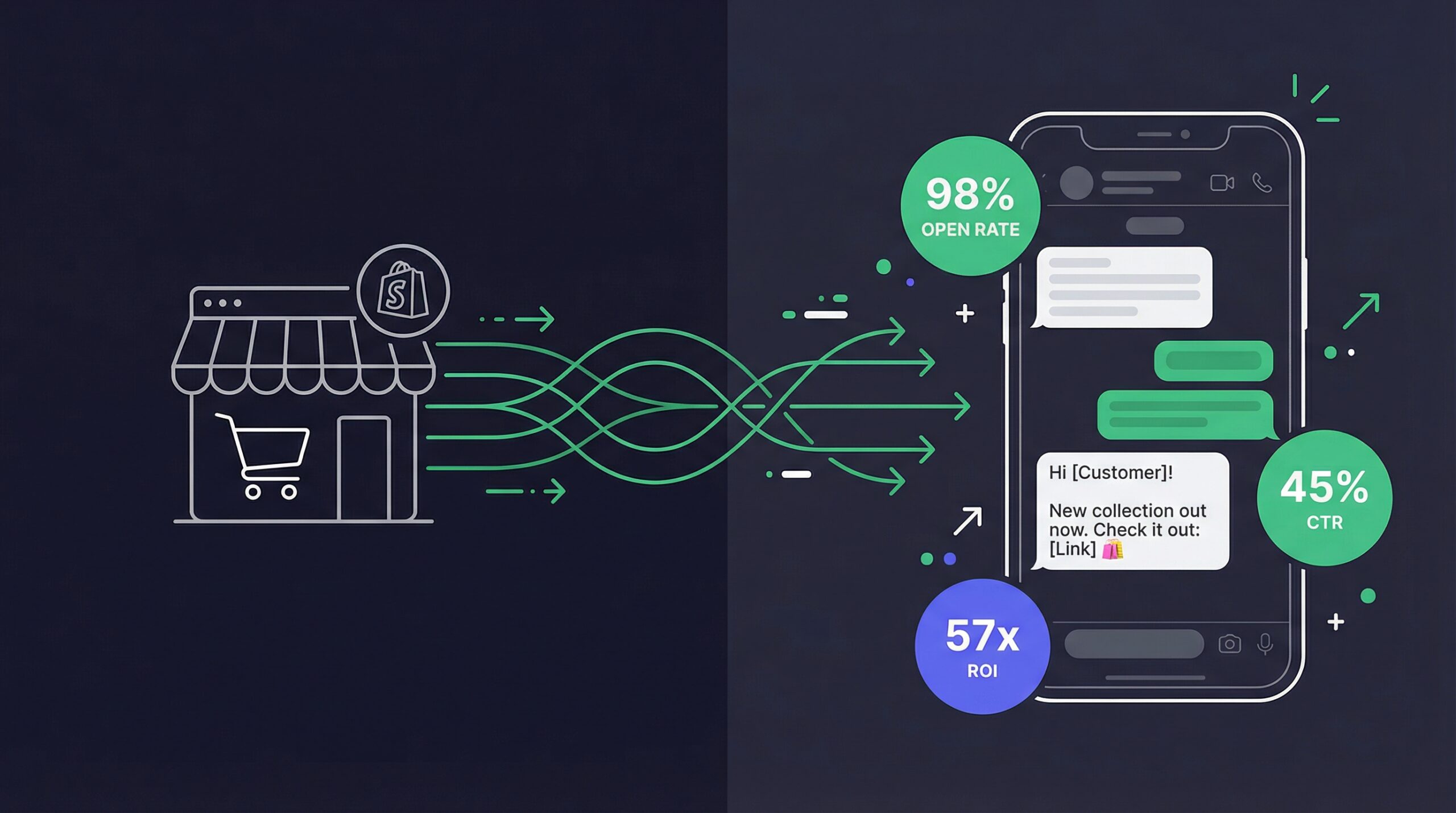
WhatsApp marketing delivers 1.7x more revenue per recipient than email and achieves 5x higher click-through rates (yCloud, 2026). Those numbers sound too good to be true until you understand why: WhatsApp sits in the same feed as messages from friends and family. Your marketing message gets treated like a personal conversation, not promotional noise.
But here is what most WhatsApp marketing guides will not tell you: the channel only works if you use it selectively. The same intimacy that makes WhatsApp powerful also means customers punish brands that overuse it. Send too many promotional broadcasts and your unsubscribe rate spikes, your account quality drops, and Meta starts limiting your messaging.
This guide covers the WhatsApp marketing strategies that actually generate revenue for Shopify stores in 2026: the campaigns worth sending, the automation flows that convert, the metrics to track, and the mistakes that get your account restricted. We are skipping the theory and going straight to what works.
Why WhatsApp Marketing Works for Shopify Stores
Before diving into strategies, here is why WhatsApp outperforms other marketing channels for ecommerce. The numbers tell the story:
| Metric | SMS | ||
|---|---|---|---|
| Open rate | 98% | 20-25% | 90-95% |
| Click-through rate | 45-60% | 2-5% | 10-15% |
| Response rate | 55%+ | 5-10% | 28% |
| Conversion rate (campaigns) | 45-60% | 2-5% | 8-12% |
| Cost per message | $0.01-0.22 | $0.001-0.003 | $0.01-0.05 |
| Two-way conversation | Built-in | Limited | Limited |
Over 50 million businesses worldwide already use WhatsApp for customer communication (yCloud, 2026). For Shopify stores specifically, WhatsApp marketing works best in three scenarios:
- High-intent moments: Cart abandonment, back-in-stock alerts, limited drops
- Personal conversations: Product recommendations, sizing help, order issues
- Exclusive access: VIP early access, flash sales, loyalty rewards
The channel fails when used for generic promotional blasts. WhatsApp marketing requires restraint and personalization that email does not.
6 WhatsApp Marketing Campaigns That Convert
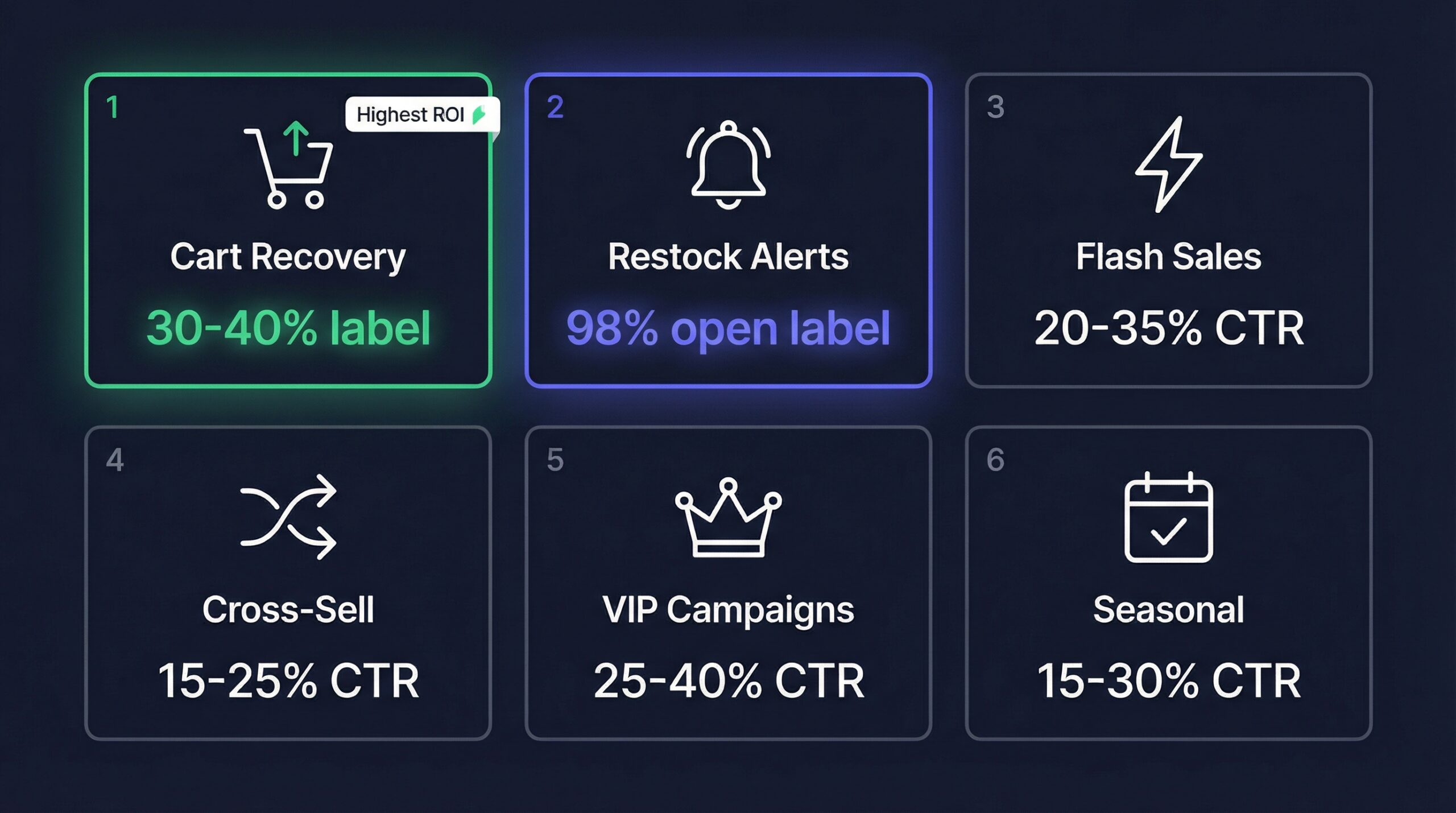
Not every WhatsApp campaign is worth sending. These six campaign types consistently generate positive ROI for Shopify stores.
1. Abandoned Cart Recovery
Expected conversion: 30-40% recovery rate
When to send: 1-2 hours after cart abandonment
This is the highest-ROI WhatsApp marketing campaign for most Shopify stores. The average store loses 70% of carts to abandonment, and WhatsApp reaches those customers faster than email.
The key difference from email cart recovery: WhatsApp allows two-way conversation. A customer who abandoned because of sizing concerns can reply directly. A customer who left because of shipping costs can ask about free shipping thresholds. That interaction converts at rates email simply cannot match.
Best practice: Send one message at 1-2 hours. If no response, send a final reminder at 24 hours. Never send more than two cart recovery messages per abandoned cart.
2. Back-in-Stock and Restock Alerts
Expected conversion: Higher than email (98% open rate vs 65%)
When to send: Immediately when product restocks
Customers who signed up for restock notifications already demonstrated buying intent. WhatsApp delivers the alert within minutes, giving subscribers a genuine advantage over email subscribers who may not see the notification for hours.
This campaign type is the bridge between your notification system and your marketing strategy. For detailed setup, see our guide on WhatsApp restock alerts on Shopify or the broader overview of WhatsApp back-in-stock alerts.
3. Flash Sale and Limited Drop Announcements
Expected conversion: 20-35% click-through
When to send: 30 minutes to 1 hour before the sale goes live
Flash sales and limited product drops require urgency that email cannot deliver. By the time most customers open a flash sale email, the best items are gone. WhatsApp reaches 80% of recipients within 5 minutes.
Best practice: Use this campaign type no more than once or twice per month. Reserve WhatsApp flash sale alerts for genuinely limited events. If customers learn that every sale is a “flash” sale, they stop responding.
4. Post-Purchase Cross-Sell
Expected conversion: 15-25% click-through
When to send: 3-5 days after delivery
After a customer receives their order and has had time to try the product, WhatsApp is an effective channel for cross-selling related products. The conversational format lets you recommend specific items based on their purchase.
Example message: “Hi Sarah! How are you liking the Hydrating Face Serum? Customers who love it also rave about our Vitamin C Moisturizer. Want to see it?”
5. VIP and Loyalty Campaigns
Expected conversion: 25-40% click-through
When to send: Segment-specific timing
WhatsApp VIP campaigns work because they feel genuinely exclusive. Sending a WhatsApp message to your top 100 customers about early access to a new collection creates a personal connection that mass email cannot replicate.
Segment ideas for VIP campaigns:
- Top 10% by lifetime value
- Customers with 3+ repeat purchases
- High-engagement email subscribers who also opted into WhatsApp
- Recent purchasers in the last 30 days
6. Seasonal Campaign Kickoffs
Expected conversion: 15-30% click-through
When to send: 1-2 days before a major seasonal event
Use WhatsApp to kick off your biggest seasonal campaigns. Black Friday early access, holiday gift guides, back-to-school collections. These are the moments where WhatsApp’s immediate visibility drives the most value.
Best practice: Send the WhatsApp kickoff, then follow up with email for broader reach. WhatsApp drives the initial surge; email sustains the campaign.
WhatsApp Marketing Automation Flows for Shopify
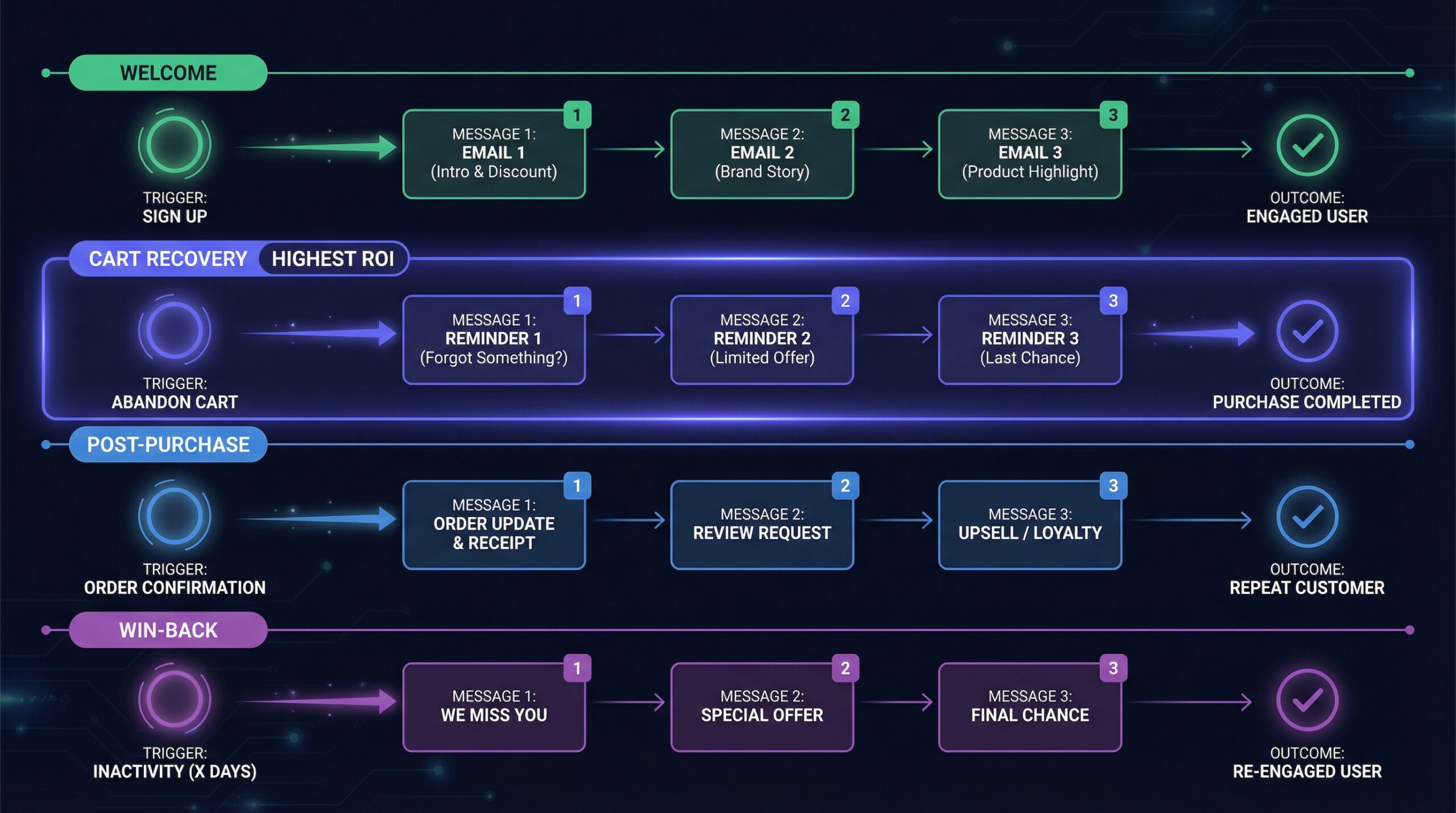
Manual WhatsApp campaigns are time-consuming. These automation flows run continuously without your intervention.
Welcome Flow
Trigger: Customer opts into WhatsApp notifications
Messages: 1-2 messages over 24 hours
The welcome flow sets expectations and provides immediate value:
- Message 1 (immediate): Welcome + discount code for first purchase
- Message 2 (24 hours): Product recommendation based on the page they signed up from
Cart Recovery Flow
Trigger: Cart abandoned for 1+ hours
Messages: 2 messages maximum
- Message 1 (1-2 hours): Product reminder with direct cart link
- Message 2 (24 hours): Final reminder, optionally with discount code
Post-Purchase Flow
Trigger: Order delivered
Messages: 2-3 messages over 7 days
- Message 1 (3 days post-delivery): How-to or care instructions for the product
- Message 2 (5 days): Review request with direct link
- Message 3 (7 days): Cross-sell recommendation
Win-Back Flow
Trigger: Customer has not purchased in 60-90 days
Messages: 1-2 messages
- Message 1: “We miss you” with personalized product pick
- Message 2 (7 days later): Last chance offer with small discount
These flows handle the majority of WhatsApp marketing revenue on autopilot. For stores already using automated restock emails, adding WhatsApp automation flows is the natural next step.
How to Measure WhatsApp Marketing ROI
WhatsApp marketing generates revenue, but it also costs more per message than email. Track these metrics to ensure positive ROI.
Key Metrics to Track
| Metric | Target | Why It Matters |
|---|---|---|
| Delivery rate | 95%+ | Low delivery means invalid numbers |
| Read rate | 90%+ | WhatsApp norm, lower indicates issues |
| Click-through rate | 30-60% | Varies by campaign type |
| Conversion rate | 10-25% | From click to purchase |
| Revenue per message | $0.50-5.00 | Depends on AOV and conversion |
| Unsubscribe rate | Under 2%/month | High rate means over-messaging |
| Cost per conversion | Under $2.00 | API cost ÷ conversions |
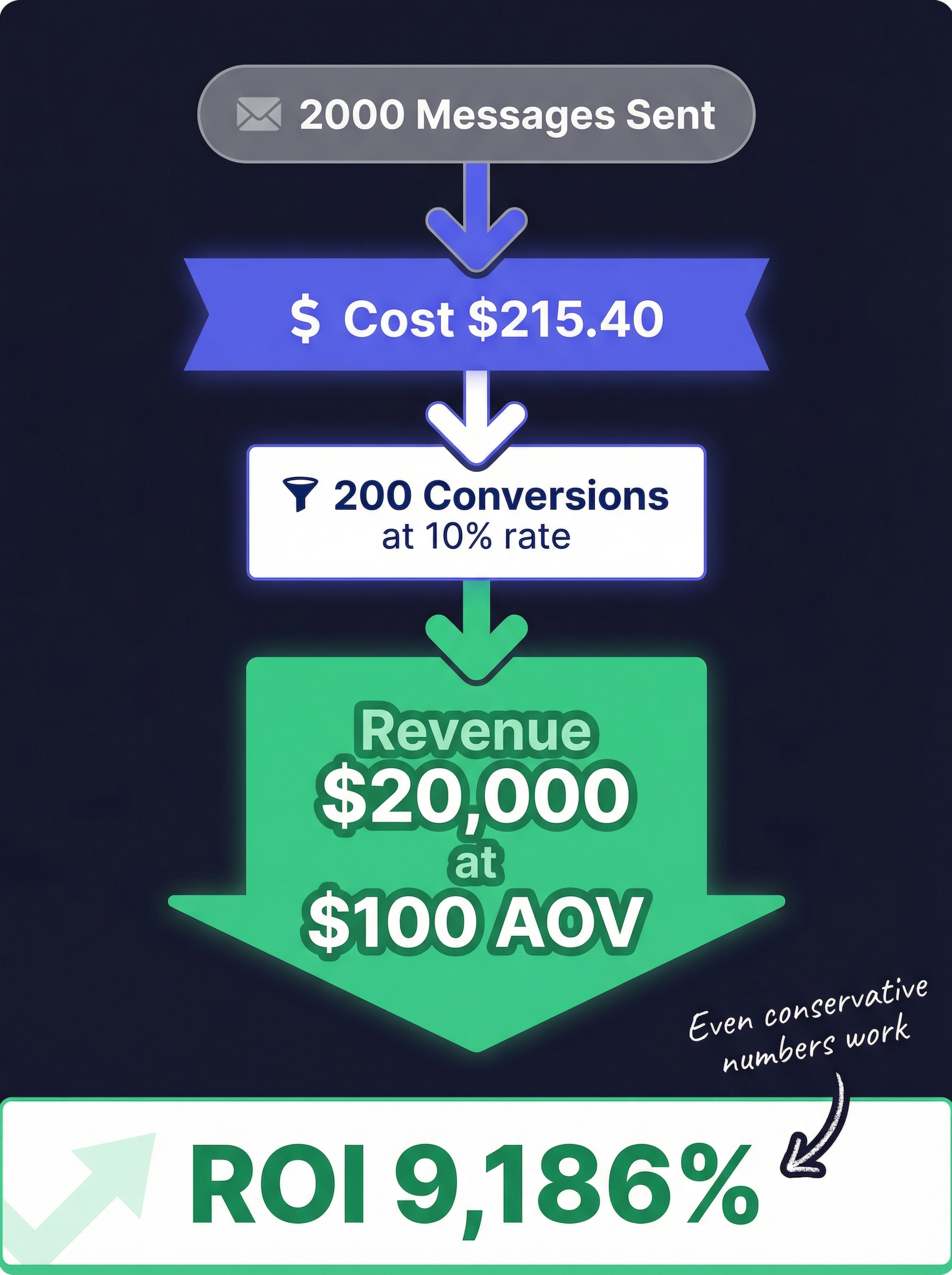
Calculating WhatsApp Marketing ROI
Here is the formula:
WhatsApp ROI = (Revenue from WhatsApp campaigns – Total WhatsApp costs) ÷ Total WhatsApp costs × 100
Example for a Shopify store:
- Monthly WhatsApp messages sent: 2,000
- Average API cost: $0.05 per message = $100
- BSP subscription: $40/month
- Total cost: $140/month
- Conversions: 200 (10% conversion rate)
- Average order value: $65
- Revenue: $13,000
- ROI: ($13,000 – $140) ÷ $140 × 100 = 9,186%
Even with conservative numbers, the ROI is strong because WhatsApp campaigns target high-intent audiences.
65% of businesses report huge ROI increases since implementing WhatsApp marketing (Amra and Elma, 2025). The key is targeting: only send WhatsApp campaigns to customers who have opted in and shown interest.
WhatsApp Marketing Mistakes That Get Your Account Restricted
Meta actively monitors WhatsApp Business API accounts for quality. Making these mistakes can reduce your messaging limits or suspend your account entirely.
Mistake 1: Sending Too Many Promotional Messages
WhatsApp is not email. Sending daily or even weekly promotional broadcasts will spike your unsubscribe rate and damage your account quality score. Limit promotional campaigns to 2-4 per month maximum.
Mistake 2: Messaging Without Explicit Opt-In
Every WhatsApp marketing message must go to someone who explicitly opted in. Importing phone number lists from other sources and sending WhatsApp messages to them violates Meta’s policy and will get your account suspended.
Mistake 3: Ignoring Template Guidelines
Templates with excessive caps, misleading urgency, or spam-like language get rejected or, worse, get your existing templates disabled. Keep messages professional, honest, and under 1024 characters.
Mistake 4: Not Providing Easy Opt-Out
Every WhatsApp marketing message should include a clear way to stop receiving messages. Most apps add “Reply STOP to unsubscribe” automatically. Removing or hiding the opt-out option violates WhatsApp policy.
Mistake 5: Same Message to Everyone
WhatsApp marketing lives and dies on personalization. A blanket promotional broadcast to your entire WhatsApp list performs worse than a targeted message to a specific segment. Always segment by purchase behavior, product interest, or engagement level.
Companies that respond within 15 minutes see up to 80% higher conversion rates (Chatarmin, 2025). If you are going to use WhatsApp for marketing, commit to monitoring and responding to customer replies. One-way broadcasting misses the channel’s biggest advantage.
WhatsApp Marketing vs Email Marketing for Shopify
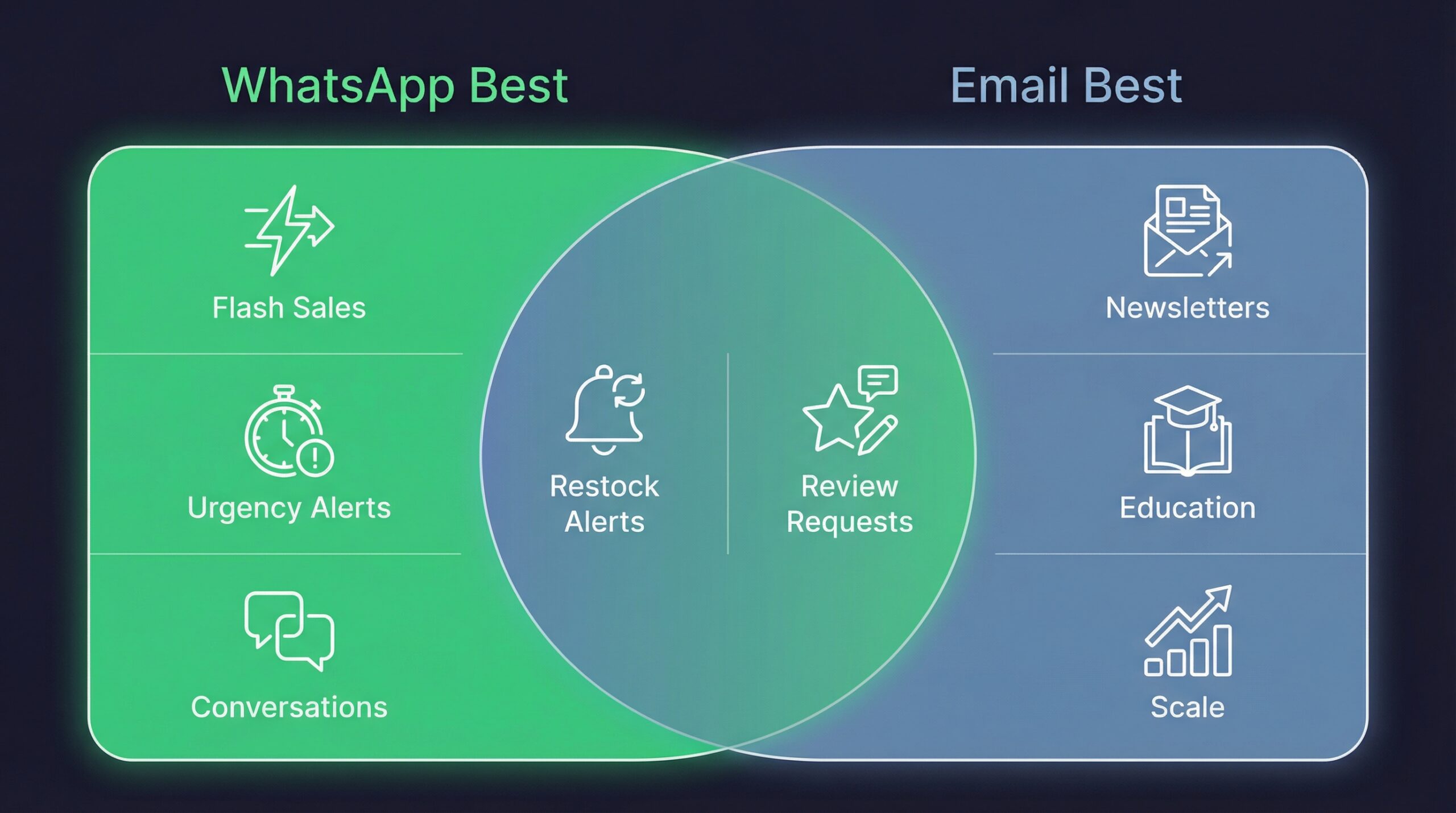
WhatsApp marketing does not replace email marketing. It complements it. Here is how to use both:
| Use Case | Best Channel | Why |
|---|---|---|
| Weekly newsletter | Cost-effective for regular content | |
| Flash sale announcement | Urgency requires instant visibility | |
| Product launch | WhatsApp first, email follow-up | WhatsApp drives initial surge |
| Cart abandonment | WhatsApp for first touch, email for follow-up | WhatsApp converts faster |
| Back-in-stock alerts | Both simultaneously | Maximum reach and conversion |
| Seasonal promotions | Email primary, WhatsApp for VIPs | Cost management at scale |
| Review requests | Either | WhatsApp gets faster responses |
| Educational content | Long-form content works better in email |
For a detailed comparison of these two channels, including cost-per-conversion math, see our WhatsApp vs email analysis for Shopify.
Frequently Asked Questions
How much does WhatsApp marketing cost on Shopify?
Total costs include a BSP subscription ($15-50/month) plus Meta’s per-message API fees ($0.01-0.22 per message depending on country). A store sending 1,000 marketing messages to US customers spends roughly $65-100/month total.
Is WhatsApp marketing better than email marketing?
WhatsApp achieves higher engagement and conversion rates but costs more per message. Use WhatsApp for high-intent, time-sensitive campaigns and email for broader, cost-effective reach. Most successful stores use both.
How often should I send WhatsApp marketing messages?
Limit promotional broadcasts to 2-4 per month maximum. Automated flows (cart recovery, post-purchase) can be more frequent because they are triggered by customer actions, not scheduled broadcasts.
Do I need customers’ permission to send WhatsApp marketing messages?
Yes. WhatsApp requires explicit opt-in consent. Customers must actively agree to receive marketing messages from your store. Messaging without consent violates Meta’s policy and can result in account suspension.
What is the best WhatsApp marketing app for Shopify?
For back-in-stock and restock alerts, StoreBeep offers the simplest email + WhatsApp setup from a single form. For full-scale WhatsApp marketing (campaigns, broadcasts, CRM), consider Zoko, DelightChat, or Interakt depending on your budget and feature needs.
Can WhatsApp marketing work for US-based Shopify stores?
Yes, but WhatsApp adoption in the US is lower than in Europe, Asia, and Latin America. US stores should use WhatsApp as a secondary channel behind email. For stores with international customers, WhatsApp may be the primary engagement channel.
What types of WhatsApp messages are cheapest to send?
Utility messages (order updates, shipping) cost 50-95% less than marketing messages. Service messages (customer-initiated within 24 hours) are free. Plan your notification strategy around these pricing tiers to optimize costs.
Start WhatsApp Marketing on Your Shopify Store
WhatsApp marketing works when you treat the channel with respect. Send fewer, better messages to engaged audiences. Automate the high-ROI flows. Track your cost per conversion relentlessly.
The practical starting point for most Shopify stores:
- Set up automated flows first: Cart recovery and restock alerts generate revenue immediately
- Build your WhatsApp list organically: Add opt-in to checkout, Notify Me buttons, and pop-ups
- Segment before you broadcast: VIP customers first, broader audiences later
- Measure everything: If cost per conversion exceeds your margin, scale back
WhatsApp marketing delivers 57.4x ROI across ecommerce brands (Chatarmin, 2025). But that ROI comes from targeted, personalized campaigns, not from blasting your entire list with generic promotions.
Start with back-in-stock notifications that support both email and WhatsApp. It is the lowest-risk, highest-reward entry point to WhatsApp marketing on Shopify.